

In this article I will present – as a native Brazilian and on the basis of more than 30 years as a professional Portuguese translator and interpreter – a few facts about Brazilian Portuguese, highlighting the significant differences between the language spoken in Brazil and Iberian (European) Portuguese.
Table of Contents
What language do they speak in Brazil?
The language spoken in Brazil is called Portuguese. Brazil is therefore the only country in all Latin America where Portuguese is spoken.
In addition, Brazil has numerous minority languages, among them more than 270 indigenous languages. Other languages are spoken in some regions, such as German (a variety of the Hunsrück dialect), Italian (actually a variant of the Venetian language) and South American Spanish (in regions neighbouring Spanish-speaking countries).
As to foreign languages taught at Brazilian schools, the most common ones are English and Spanish. French was the most common foreign language learnt at school in Brazil, but nowadays it’s taught mostly in Amapá, a Brazilian state neighbouring French Guiana.
By the way, the 730 km wide border between Brazil and the overseas department French Guiana is the longest French border with any country. And, yes, Brazil shares a border with the European Union!
What is Brazil’s official language?
Portuguese is Brazil’s official language, i.e. the language in which Brazilian official documents are written and is the basis of the entire Brazilian bureaucracy.
In Brazil, as opposed to Germany and Portugal, there are no multilingual official documents. Documents written in a foreign language must be translated into Brazilian Portuguese if they are to be legally valid in Brazil.
Why do Brazilians speak Portuguese?
Brazil was “discovered” in 1500 by Portugal, which at the time was a maritime power. The indigenous peoples that had inhabited the land for many centuries and spoke numerous other languages were gradually reduced to a minority as a result of violence and/or low immunity to European diseases. In addition, other European settlers in the 16th and 17th centuries – such as the French and the Dutch – haven’t left as significant a language heritage as the Portuguese. That’s why Brazilians speak Portuguese.
A similar development happened also in most other Latin American countries after the “discovery” of the Americas by Spain in the year 1492. Due to the Treaty of Tordesillas (1494) and the Treaty of Madrid (1750) between Portugal and Spain, each of these maritime powers owned a part of South America, the West became Spanish and the East – where the current Brazilian territory is located – became Portuguese. That’s why Brazilians speak Portuguese instead of Spanish.
What other languages are similar to Portuguese?
Portuguese belongs to the so-called romance language family – also known as Neo-Latin languages, i.e. languages that originate from Latin. This language family also includes Spanish, Catalan, French, Italian and Romanian.
This explains why a Brazilian can understand other romance languages with some relative ease – similar to how a British can roughly understand Dutch or Danish.
Is Brazilian the name of Brazil’s language?
No, there is no language called Brazilian! The name of Brazil’s official language is Portuguese.
Portuguese is the official language in ten countries. Other countries apart from Portugal and Brazil include Angola, Mozambique, Cape Verde and Guinea-Bissau. Brazil has by far the largest population with well over 200 million inhabitants – 20 times more than Portugal. The influence of Brazilian Portuguese – for example, through the export of TV shows and music – is tremendous. Nonetheless, this hasn’t been enough to develop a separate language called “Brazilian”.
Brazilian is an adjective, not a noun. There is Brazilian Portuguese, Brazilian culture, Brazilian soccer, Brazilian beaches – but not “Brazilian” as the name of Brazil’s language.
Two subjects studied by pupils at Brazil’s schools are “Portuguese Language” and “Brazilian Literature”. This shows that Brazil and Portugal have had distinct literary developments – and therefore distinct language variants, but it also demonstrates that both countries still share the same language.
This is not something new: Spanish is a language, whereas “Mexican” or “Argentinian” are not; the same applies to English as opposed to “American” or “Australian”. So why should it be different with Portuguese and “Brazilian”?

Portuguese translator in Hamburg


Portuguese translator in Berlin
Why are there differences between European and Brazilian Portuguese?
The differences between European and Brazilian Portuguese exist because there is literally an ocean between Brazil and Portugal – a geographic vastness spanning at least 6,000 kilometres! As a result, aspects of life such as culture, the legal order and the political system in each country and, therefore, the language that is spoken there developed differently, as one would expect it to happen.
The phenomenon of regional differences within the same language is called linguistic variation.
How do Iberian and Brazilian Portuguese differ from each other?
First of all, it’s important to note that someone from Portugal can keep a conversation with a Brazilian, and they can understand each other. However, this happens only with a certain amount of struggle from both parts. In general, they can understand each other because both their home countries share the same language.
The differences will certainly be felt when the situation involves more than a nice conversation – for example, a job interview, a meeting with a business partner, a court hearing, a marketing campaign. In all of these situations, it’s absolutely important that both parties understand each other or that the target group feels directly spoken to. As you can see, it’s about nuances – the small things that can contribute to success or failure.
Here’s an example from the legal practice:
A Brazilian man appears before a court in Germany. But the interpreter assigned by the court itself or the public prosecutor’s office speaks Iberian Portuguese. During the proceedings, the Brazilian man keeps hearing awkward words such as “arguido“, and verbs in the second person singular often lack a subject – which causes him to not realise (if formal, not familiar language is used) that people are talking to him.
This happens because the word “arguido” is not used in Brazilian Portuguese, at least not in the sense of “defendant”; the words “réu” or “acusado” are used instead. In addition, specifically in Brazil, sentences without an explicit subject are something one would find in literary contexts, not in spoken language, definitely not in legal language, and verbs in the second person singular without a subject are not used when talking directly to someone. This would have sounded more or less like “Have they [third person plural] committed a crime?” instead of “Have you [second person singular] committed a crime?”.
Differences in specialised language
It’s not just the different legal systems that separate Brazil from Portugal. Other differences include the domains of education, public administration and the political system. All this reflects, of course, in specialised language. For instance:
In Portugal, the first university degree is “licenciado” (equivalent to a bachelor’s degree). But in Brazil the same word refers to a degree obtained after completing a teacher training at university level, whereas the most common degree of “bacharel” (bachelor) is only obtained by students who opted for a scientific training as opposed to a teacher training.
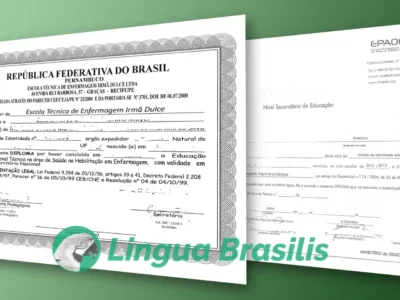
Translation workshop in Frankfurt: Brazil’s education system
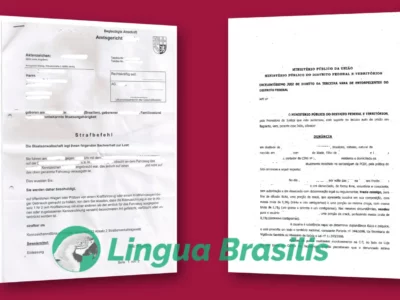
Brazilian criminal procedure for translators in Frankfurt
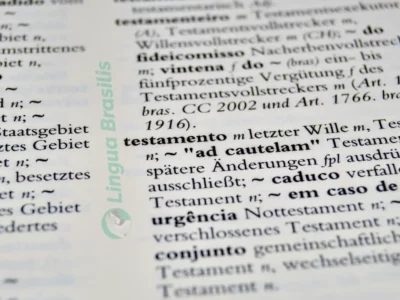
Translation workshop in Frankfurt: Brazilian succession law
Differences in everyday language
There are significant differences in everyday language as well. For instance:
Unknowing Brazilians find the name of the famous Portuguese custard tarts “pastéis de nata” especially hard to understand, because in Brazil “pastéis” refer to fried dumplings.
Brazilian men’s underwear is called “cueca”, a word that is used in Portugal with the meaning of ladies’ underwear!
A Portuguese girl is simply a “rapariga”, but in Brazil this word refers to a lady prostitute.
A Brazilian t-shirt is called “camiseta”, whereas the same thing in Portugal is called “camisola”, a word that Brazilians use in the sense of nightgown.
Did the 2009 spelling reform create an international Portuguese?
No. There have been different spelling reforms at different times in Portugal (1911, 1945, 1973) and Brazil (1943, 1971).
The first successful attempt at a more or less shared spelling reform in both countries only came into effect in 2009, after 19 years of discussions, and became known as Acordo Ortográfico de 1990.
Unfortunately, the 2009 spelling reform only affected 2% of the Portuguese language vocabulary. Of those, only about 1.6% are spellings that are not typically Brazilian, which means the Portuguese have had to adapt to the new spelling more than Brazilians.
Also, many local spellings – and, of course, local meanings of words – remained unchanged. Therefore, the spelling reform did not produce an internationally neutral Portuguese language.
What does variation within the Portuguese language mean for customers who need a Portuguese translator or interpreter?
All the above facts have very real consequences for Portuguese translation and interpreting services:
Texts to be used in Brazil – be they official documents or love letters – must be translated by a professional translator who is well versed in the Brazilian Portuguese language variant. This is an absolutely minimum quality requirement if a translated text is to be well received by its intended target audience.
Many fellow Portuguese translators claim to be qualified for translations into both Iberian and Brazilian Portuguese, but the reality tells a different story.
The same applies to translations from Brazilian Portuguese into English. In this case, words and between-the-lines meanings that are typical of Brazil’s cultural space risk being misunderstood or incorrectly transferred – due to a lack of intercultural skills on the part of a translator not specialised in Brazilian Portuguese.
Here is an example straight from my professional experience as a Brazilian Portuguese translator and interpreter since 1993:
Unfortunately, at multinational companies – and at many “multilingual” translation agencies – there is often no distinction made between Portuguese language variants. As a consequence, texts that have been translated in Portugal fail to communicate to Brazilian target groups, and translations have to be urgently “Brazilianised“. Or, worse still, they have to be redone from scratch into Brazilian Portuguese by a professional Brazilian Portuguese translator. All this leads to increased translation costs – which at the same time increases the other costs of producing materials such as marketing brochures, corporate guidelines and business websites.
One should therefore avoid such a mistake and hire a qualified Brazilian Portuguese translator right from the start.
[I wrote an early version of this article in German and English for my clients many years ago; a second German version appeared years later on the translation journal Hessen-Info. Elsewhere on this website you will find an overview of my published writings on translation and terminology.]
