
On 31 August 2019 I attended a one-day seminar for translators in Hanover on how to use text corpora as linguistic resources in translation work. The seminar was organised by the German Federal Association of Translators and Interpreters (Northern Germany Chapter) and presented by Anna Fankhauser, a member of the research team with the Institute for English and American Studies at the University of Osnabrück. It gave participating translators a theoretical overview of corpus linguistics and a practical introduction to working with text corpora and showed how corpora can be used to achieve higher quality and productivity in translation.
Table of Contents
Definition of text corpora
The seminar opened with a term definition: What are text corpora? In short, a corpus (plural: corpora) is a huge collection of selected authentic texts – written in a certain language or language variant, taken from a certain knowledge area, from a certain publication, etc. Because they are authentic, such text collections reflect language use and contextualised language.
They are, therefore, extremely useful when you want to know in a scientifically accurate manner:
- how often a certain word appears in a certain context,
- what wording is frequently used before/after a certain word,
- how language evolved through time, or
- what the most validated translation of a certain specialised term is.
All of that is, of course, an essential part of translation work – whether or not the translator is aware of it; after all, a conscientious professional translator will always want to use the right term and the right language style. Apparently, however, not many translators have been using text corpora systematically.
Types of corpora
This was followed by a discussion of the different types of text corpora: they can be general (such as reference corpora) or specialised (such as dialect corpora).
There are different kinds of multilingual corpora as well:
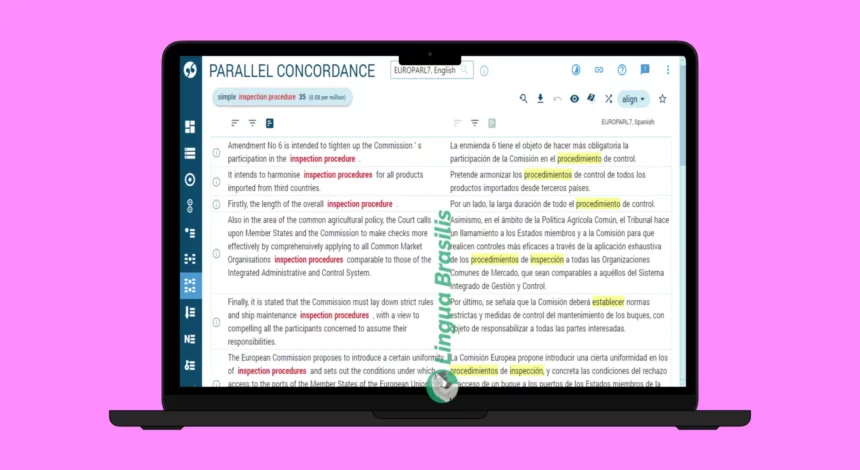
- In a translation corpus (parallel corpus) the texts are stored with their respective translations.
- A comparable corpus, in its turn, stores original texts, each in a different language, that more or less correspond to one another or contain more or less the same terms in their language.
All of these types of corpora are created, maintained and searched with specific programmes. These, in turn, calculate things such as the position of words and their grammatical categories.
Corpus analysis tools
After that, the presenter gave us an introduction to working with corpus analysis tools. There are web-based corpora such as Sketch Engine and English-Corpora.org, and downloadable concordance programmes such as AntConc.
Finally, the functionalities of Sketch Engine were extensively demonstrated, such as: different search features and the user interfaces named “Collocations” (for wording that appears before/after a certain word) and “Word Sketch” (for grammatical categories).
During the seminar’s exercise part, participants were able to put the newly acquired knowledge in practice and get to know the programme better. AntConc, which is a free programme, was also briefly discussed.
Conclusion
This was already my second CPD event for translators in Hanover, and it certainly won’t be the last one. The local BDÜ chapter made sure everything was well organised. And because of her expertise and teaching experience, the presenter was able to fascinate us with such an arid topic. In the end, all of us were convinced that text corpora can be used in a systematic and productive way in our translation work.
Event details
| Type of event | one-day seminar held in German |
| Title | “Alleskönner Textkorpus: Verlässliche Ressource für Terminologieextraktion, Übersetzungsbeispiele und authentischen Sprachgebrauch” [Text corpora as all-round reliable resources for terminology extraction, translation examples and authentic language use] |
| Event organiser | German Federal Association of Translators and Interpreters, Lower Saxony chapter |
| Facilitators / Presenters | Anna Fankhauser |
| Date | 31 August 2019 |
| Place | Hanns-Lilje-Haus • Knochenhauerstraße 33 • 30159 Hanover • Germany |
| Main topics | • Corpus linguistics: definition and areas of application of text corpora • Types of corpora: general, specialised, parallel, comparable • Corpus analysis tools: Sketch Engine and AntConc • Text corpora in day-to-day translation work |
