
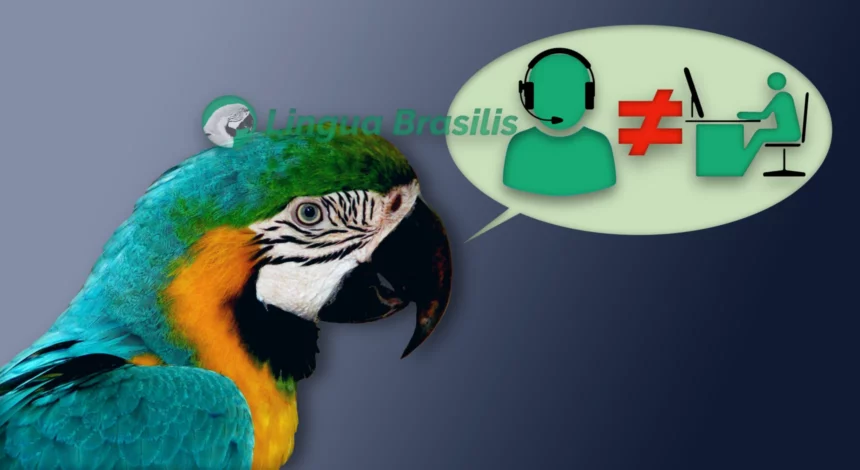
Interpreting, i.e., spoken translation, requires very different skills from those required of translators. Because of that, a good translator is not necessarily a good interpreter.
In this post written especially for customers of Lingua Brasilis, my German-based translation business, I’ll explain how interpreters and translators differ from each other, what skills interpreters have to have, and what interpreting modes there are.
Table of Contents
What is the difference between interpreting and translating?
Simply put: Interpreters translate spoken statements into a different language, whereas translators translate written statements.
However, there are situations in which spoken statements in one language are to be set down in writing in another language, such as during a telecommunications surveillance.
Also, interpreters don’t necessarily have to translate into another language. This is the case, for instance, with speech-to-text interpreting, i.e. when transcribing the spoken word, either in full or in summarised form, in the same language, specifically for the hearing impaired.
The verb that describes the work of classic interpreting as well as that of translators is “to translate”, whereas the verb “to interpret” applies only to the former.
However, what professional interpreters find annoying is not the wrong verb, but the wrong way of naming their profession.
For example, when an interpreter appears on television, most people associate the image to a “translator”. In contrast, when a public servant – even court officials and judges, who should know better – are in search of a “translator” (of written documents), they often say “interpreter”.
As it seems, the confusion is relatively widespread and common. But the difference is so easy to understand! Here is a memory aid applicable to most situations:
spoken translation = interpreter
written translation = translator
Are language skills enough to become an interpreter?
Of course not! Someone who simply has language skills is far from being an interpreter. Someone who was raised bilingual is simply twice a layman and not automatically a good interpreter.
In addition to perfectly mastering both languages, interpreters must have at least the following capabilities and skills:
- terminology capabilities for acquiring specialised terms and the language used in the subject area to be translated;
- high level concentration for simultaneously hearing and speaking while understanding the speaker’s body language (in conference interpreting);
- excellent short-term memory for memorising elements of a statement and subsequently translating them in a structured and fluent way (in consecutive interpreting);
- broad general knowledge for quickly identifying and understanding references, wordplay, jokes and impromptu cultural elements, and correctly translating them in the other language or adapting them in a way that is faithful to their meaning;
- an individual note-taking technique (for consecutive bilateral interpreting), and
- a cultivated speaking voice.
Those are no esoteric skills available only to divine creatures. They can be learned and practised in proper interpreter training.
How to spot a nonprofessional interpreter?
Nonprofessional interpreters, i.e. those without proper interpreter qualifications, translate what was said by the speaker in the third person (“Mr. XYZ said he did not commit the crime.”). Here, the interpreter plays an active role in the conversation, which can bias the perception of the statement considerably.
Professional interpreters translate this kind of statement in the first person (“I did not commit the crime.”). Now, the interpreter is made invisible in the communication process and is nothing more than a second voice for the speaker in another language.
What is conference interpreting?
Simultaneous interpreting is the interpreting mode in which a speech is held and simultaneously translated. There is no time delay between what was said and the corresponding translation.
Conference interpreting is the most common form of simultaneous interpreting. It is aimed at simultaneously several people, such as during a conference or similar event.
Given the lack of time delay, simultaneous interpreting mode requires a huge level of concentration. That’s why professional conference interpreters usually work in teams of two in a booth, and the microphone is given to the booth partner every 20 minutes or so.
What is consecutive interpreting?
In consecutive interpreting, a statement is first spoken and subsequently translated. This extends the duration of the meeting, because everyone must wait until the interpreter has finished translating the statement in question.
Consecutive interpreting is therefore ideal for short meetings and for situations in which an interpreting booth is not available. This is the case, for instance, in notarial interpreting (spoken translation at a notary public).
What is whispered interpreting?
In whispered interpreting (also known as “chuchotage”), much just like in conference interpreting, statements are translated simultaneously – i. e. at the same time –, but for just one person. The interpreter places themselves directly near the person and speaks with low voice.
The advantage of this interpreting mode is that the interpreting process is not made public, as it’s intended for just one person. Also, the speaker can go on speaking without being disturbed or interrupted.
Whispered interpreting is suited for diplomatic meetings in very small groups, for community interpreting or situations in which someone only has to understand a speech passively and doesn’t necessarily need to say anything.
On the other hand, whispered interpreting ist also used at courts of law, though almost always combined with consecutive interpreting.
