
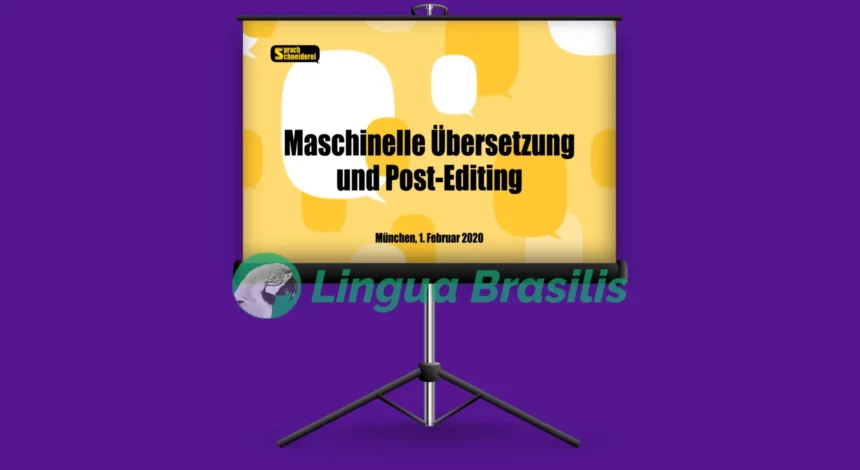
Within the context of the Digital Revolution in the translation industry, a new professional field has emerged: post-editing of machine translations. As a professional translator, I’ve faced machine translation (MT) for 10 years – though only at translation conferences, and every time I notice that there has been notable progress in this area and sense that more and more translation industry participants have accepted this new technology. Many believe that the work of a translator will soon consist in editing machine-translated content, that is, improving such content according to customer specifications, at least as long machines are not capable of producing translations that are perfect both in terms of style and in terms of specialised jargon.
I wanted to know more about it (and above all, in a systematic way) in order to be prepared for the future, so I decided to attend a day-long seminar on “Machine translation and post-editing” that was organised by the German Federal Association of Interpreters and Translators in Munich and presented by Sara Grizzo, who is a well-known Italian MT-expert. Here is some basic information on the seminar:
Event details
| Type of event | one-day seminar held in German |
| Title | “Maschinelle Übersetzung und Post-Editing” [Machine translation and post-editing] |
| Event organiser | German Federal Association of Translators and Interpreters, Bavaria chapter |
| Facilitators / Presenters | Sara Grizzo |
| Date | 1 February 2020, from 10 a.m. to 5 p.m. |
| Place | Headquarters of BDÜ’s Bavaria chapter • Rottmannstr. 11 • 80333 Munich • Germany |
| Main topics | • A theoretical introduction to machine translation: definition, different technologies (rules-based, statistical, neural) with their respective strengths and weaknesses • Post-editing in practice: requirements, workflow, best practices |
