
I started my translation career in Brazil and developed it further in Germany. Because of that, throughout the years, I was able to gather a few personal insights into the similarities and differences regarding the Brazilian and German translation industries. They are the subject of the seventh article in the series celebrating my 25 years as a professional translator.
Table of Contents
Translation, an unregulated profession
First, let’s discuss a similarity: translation in general is an unregulated professional both in Brazil and in Germany. This means that everyone can call themselves a translator and effectively work as a translator without having to present proof of qualifications.
As a result, there is, both in Brazil and in Germany, a huge gap between qualified and quality-conscious professionals on the one hand and unqualified, mostly cheaper language vendors on the other hand, and customers aren’t always able to separate the wheat from the chaff. An exception is the work of sworn translators, who must receive a professional licence and therefore enjoy a special status within the translation industry of both countries.
Translating into one’s non-native language
In Germany, a common standard is that translators translate only into their mother tongue (this is called the “native speaker principle”). Translating into one’s non-native language is considered a second option when, for instance, no suitable native speaker is available.

In Brazil, contrary to the situation in Germany, translating into a foreign language is very common, and this service even has its own name: “versão” (transfering) as opposed to “tradução” (translating). In addition, a translator in Brazil is more often expected to translate into a foreign language, which is the norm in the country. The reason for that can only be speculated about.
Maybe it’s because the number of people (including translators) living in Brazil who are native speakers of a foreign language is so much lower than in Germany. Also, the Brazilian job market is more focused on local professionals with good local contacts, and – just like the Brazilian economy in general – is very protectionist, so that foreign professionals find it relatively difficult to gain a foothold in Brazil. Buying translations outside of Brazil is in most cases out of the question, as foreign vendors are usually too expensive because of the currency exchange rate and the country’s tax regulations. The Brazilian translation industry simply accepts the risks of translations by non-native speakers of the target language turning out to have quality deficiencies.
Bureaucracy for translation entrepreneurs
In Germany, establishing a translation business as a solo entrepreneur is relatively fast and straightforward. It’s also usually very easy to work as a freelance translator for large companies, because the hurdles are more of a logistic and organisational nature (for example, how many languages a single freelancer is able to translate into and how long it takes for all translations to be completed).
In Brazil, on the other hand, the hurdles are primarily related to taxes and bureaucracy: companies and publishing houses don’t want to hire freelance translators because that would increase their taxes and social security contributions and would lead to more bureaucracy. Officially, Brazilian companies justify their strategy saying they want to avoid the risk of false self-employment. Brazilian translators who establish a company (as opposed to a freelance business) have better market chances – but at the same time they do have to carry a heavier tax burden and considerably more bureaucracy when managing their companies.
Importance of translators’ associations
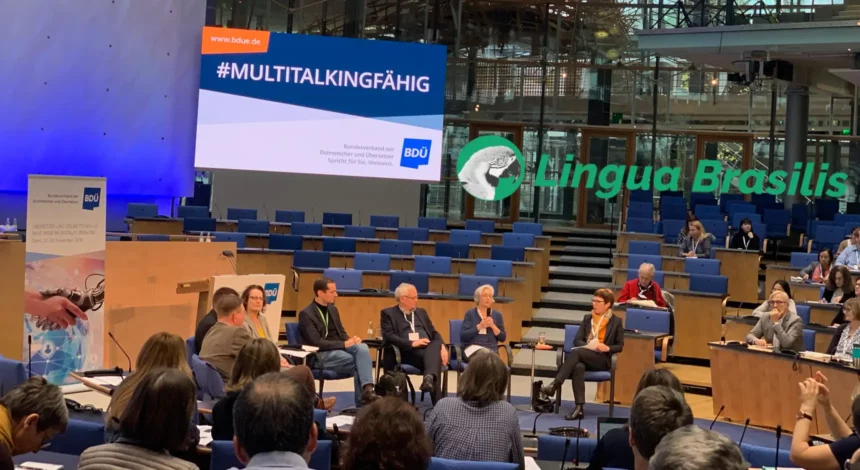
There are numerous professional translators’ association in Germany, the largest of them being the Bundesverband der Dolmetscher und Übersetzer (BDÜ). German associations defend the interests of their members mainly at the political level (and are even invited to take part in discussions before relevant legislation is passed), offer professional development opportunities on a regular basis, and encourage local, regional and federal translator gatherings with lively discussions.
In Brazil, on the other hand, there are only a few associations for language professionals, most of them focusing on local sworn translators. They are quite centralised in terms of administration and offer almost no professional development opportunities. Moreover, organising a translator gathering in Brazil is – in my own personal experience – a huge challenge, because Brazilian colleagues, who are very internet-savvy, seem to prefer online networking, which is open to everyone who calls themselves a translator. As a result of all of that, there is, sadly, little solidarity in the Brazilian translation industry.
