
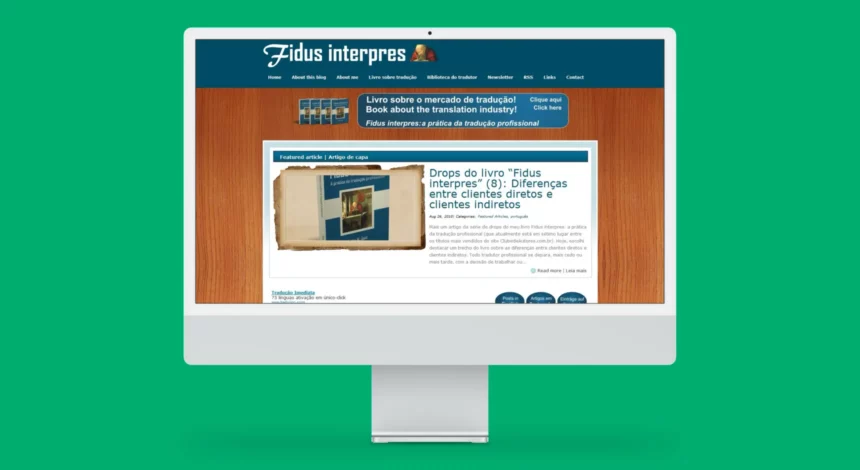
I’ve owned four different translation blogs since 2006, enjoying many opportunities to network with fellow translators from numerous countries and varying speciality niches. First, I had a Portuguese-language blog to exchange information with Brazilian colleagues. It was followed by a more ambitious project: a trilingual blog with much more content reaching about 2 million visitors and resulting in a successful book. After five years of intensive networking with the international translation industry, I founded a blog with systematic educational content for novice Portuguese translators. Nowadays, I have only this blog for customers of my translation business.
In the following eighth part of an article series celebrating my 25 years in the translation industry, I will discuss what I’ve learned so far as a blogging translator.
Table of Contents
Translators are not necessarily the nicest colleagues
My first translation blog – named “Vivendo e Traduzindo” (in English: A Translator’s Daily Life) – was founded in 2006. Its purpose was to exchange ideas with the Brazilian translation industry and share interesting facts about the translating profession – but without claiming them to be complete or systematic.
At that time, I had already accumulated 10 years as a translator, but it was only a couple of years before that I had had my first contact with translators from outside my home city. Due to the blog, I was mostly able to arouse colleagues’ curiosity (translators are curious people by nature!), while also making new good virtual friends as well as gaining a couple of new customers from the publishing industry and quite a few enemies.
It didn’t take long before I realised how competitive the world of English translation was and still is. Exactly for that reason, some fellow English–to-Portuguese translators were apparently offended when I, for instance, wrote about my own translation workflows or my personal industry observations, as if my work methods would invalidate theirs.
Others would even leave nasty anonymous comments and try to intimidate me. And there were those whose curiosity was so great (and apparently had so much time in their hands) that they skyped me – even from other countries – hoping to involve me in dubious talks. All of them were English-to-Portuguese translators. In contrast, German-to-Portuguese translators were much friendlier and less suspicious. This certainly has to do with the tougher competition prevailing in the English language translation industry, in which colleagues with comparable qualifications are considered primarily as competitors.
Translators are passionate networkers
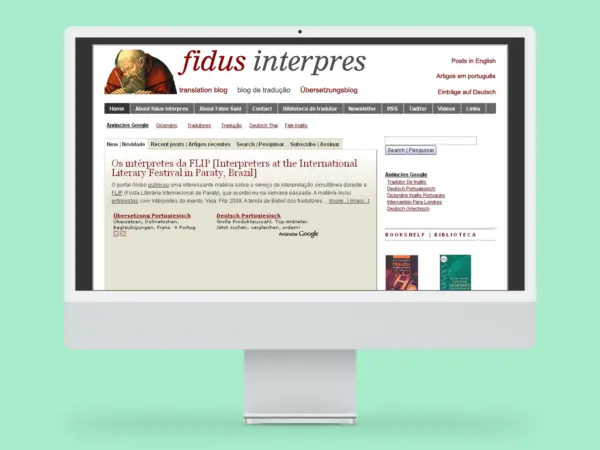
In my second blog, I wanted to reach an international audience. Its name, “Fidus Interpres”, was borrowed from Horace’s “Ars poetica”, meaning “faithful translator”. I posted in English, German and Portuguese – but each article was published only in a given language depending on content relevance, instead of appearing simultaneously in all three languages.
Discussed topics included terminology work, interpreting, translation conferences and translation environment tools. I miss that period in my life so much, because that was when I had the most fun as a blogging translator. Back in 2008, there used to be a certain innocence about the translation blogosphere, and most blogging translators of that time were posting things for fun, not with a blatant commercial intention like today’s.
My blog posts generated such great response that, for example, I was invited by the American Translators Association to speak at their annual conference, won quite a few new clients from the publishing industry and was able to influence a little bit the software development of a now famous translation environment tool after I published a negative review on the blog.
In addition, I could clearly feel, in the many comments left by fellow translators form all over the world, that we translators are passionate networkers. It simply was fun sharing our own insights with one another, discussing complicated terminology problems, scrutinizing the state of the translation industry and making the general public more familiar with our profession. I tried to capture this atmosphere in my 2010 book titled “Fidus interpres”, which was inspired by the blog.
Translators have a thirst for knowledge

For my next venture as a blogging translator, I wanted yet again a deeper level of discussions with Brazilian colleagues, posting only in Portuguese. In addition, the new translation blog was supposed to be more structured and focus on helping novice translators – hence its name, “Guia do Tradutor” (literally: “A guide for translators”). The blog was created to support my second book on translation.

During the blog’s two-year run, I was able to confirm once again that translators have a thirst for knowledge. Mostly young students – but also translators with a background in other areas or with more years of experience – posed interesting questions, shared their own experiences and made informed improvement suggestions to eliminate deficiencies in Brazilian academic translator training. How could it have been different? After all, the core of the translating profession is about acquiring and expanding knowledge, so that it shouldn’t surprise when translators show a high degree of intellectual curiosity.
Translators want to be helpful to customers
Currently, I’m running only one translation blog as as part of my business website. Exchanging ideas with fellow translators still takes place – less intensively – through other channels such as Facebook, Twitter or LinkedIn. The reason why I’m currently focusing on customers is that, first of all, there are so many blogs for translators out there, and also because a blog for translation buyers makes more sense in the context of my current business model focusing on direct clients and private individuals.
Here, there is no comment functionality (in order to minimise the time spent in managing personal data and complying with data protection regulations), and the blog works more like a professional PR platform, but one that focuses on, amongst other things, useful content for my customers. Moreover, the fact that all posts are published simultaneously in three languages, when relevant, helps with finding the right audience.
Apparently, my current customer-focused blogging since 2014 has worked pretty well, as I often hear feedback from customers who say they came across clear and time-saving information on my blog related to German-Brazilian bureaucracy, for example. That’s exactly the goal I wanted to achieve. For me, it’s the right way to have good fun as a blogging translator.
