
In this month’s article from the series about my first 25 years in the translation industry, I want to share a very special experience I had: my first encounter with the German language – a language that completely changed my life. As a native of Brazil and a translator, I invariably get asked: Why German? Here is my answer to this question.
Table of Contents
A difficult decision: which foreign language to study next?
In the last year of my vocational training as an English-to-Portuguese translator at a boarding school in Brazil, there was a possibility to learn a second foreign language that was not part of the curriculum, complementing one’s language skills. I was unsure whether I should choose Spanish or maybe French, and I kept postponing the decision. Then came the summer break before the last school year, and I travelled back home.
At that time, a Brazilian TV station had a late-night programme once a week showing foreign-language movies with subtitles. I already knew the programme and used to watch classic films in English or French. On a certain Monday night sometime during the summer, they were showing a “German” film: Mephisto (1981). So I thought, ‘Why not?’
The movie Mephisto
The movie was an adaptation of the well-known novel Mephisto – Novel of a Career by Klaus Mann. It starred Austrian-born Klaus Maria Brandauer, who played a 1920s and 1930s German actor torn between remaining true to his art and conforming to Nazi culture. It was actually a German-Austrian-Hungarian co-production with mostly Hungarian actors and had won the Academy Award for Best Foreign Film for Hungary the year before. The version I watched was either spoken or dubbed in German.
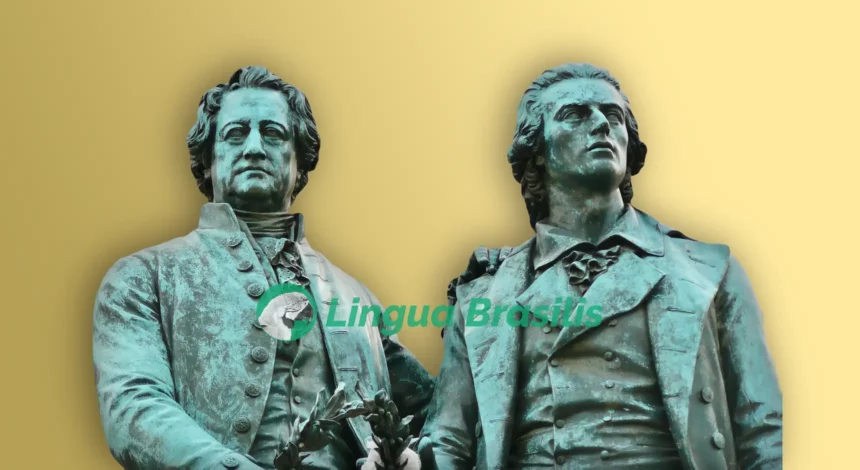
That was the first time I ever heard someone speaking the language of Goethe and Schiller. Unfortunately, it had to be in the context of Germany’s Nazi history. On the other hand, maybe it was supposed to be that way; after all, the Nazi period and having to deal with the heavy weight of history are part of Germany’s culture.
As someone who grew up speaking Brazilian Portuguese as a mother tongue and later learned English as second language, I found German a very expressive language. Not a beautiful language – at least not at that time. Not melodious, either, in the sense more commonly applied to Italian or French. But somehow it sounded incredibly interesting and fascinating.
I spent the next couple of days after watching the film trying to process its impact and its language. After that, I was certain: That was it, the next foreign language I simply had to learn! However, at that time I didn’t want to learn German as a working language – I just wanted to have fun with it.
Self-studying the German language – with a textbook and cassette tapes
On my return to the boarding school after the summer break, I found out that German wasn’t available to be studied as a second foreign language, as the school had no German teacher. However, it did have a lot of resources for those willing to self-study the language. I took a look at what the school’s library had to offer and chose a German language course comprising of a textbook, a practice book and cassette tapes. The course included a very strict learning routine: I had to self-study and practice every day for 15 minutes during 4 months. And I did – after all, I was living in a boarding school, and time was not a problem.
The Goethe Institute – my second home
I don’t know anymore what proficiency level I acquired with just self-study. However, when I moved to the big city several months later to start my mandatory work experience period, I went to the local Goethe Institute and took an admission test. The test proved that the daily 15-minute-a-day-for-4-months routine was enough to skip the whole first semester at the Goethe Institute, so that I was accepted as a second semester student. A few years later, I skipped another semester after obtaining the German as a Foreign Language Certificate with the highest grade (“sehr gut”).
The Goethe-Institut Salvador (also known by locals as Instituto Cultural Brasil-Alemanha) was not a mere language school – it also had been an important hub for the cultural landscape in Salvador since 1962, at a time when Brazil was still living under a military dictatorship. From the moment of that admission test and for 4 years after that, it was like a second home to me.
I attended class twice a week in the evening, but as I lived very near the Goethe Institute I constantly stopped by to read the Süddeutsche Zeitung or the Spiegel, to watch comedian Loriot’s old TV sketches on videotape or to attend film exhibitions featuring the works of R. W. Fassbinder. Every semester I was the student with the best grades in my class and was rewarded with a present.
For each year’s best intermediate-level student overall, the reward was a very special present: a scholarship for a language stay in Germany. I was the lucky scholarship winner in 1996. More about that in the next article of this series.
