
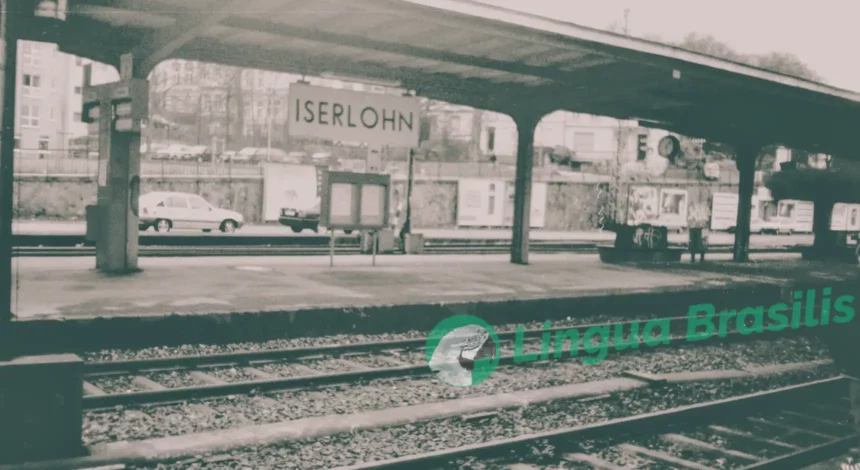
In the winter of 1996/97, I came to Germany for the first time as the winner of a scholarship from the Goethe Institute, staying in Iserlohn (in the Sauerland region). In the third part of my article series celebrating 25 years in the translation business, I’m sharing what I experienced at that time and how my language stay in Germany changed my future as a translator.
Table of Contents
Why going on a language stay in Germany?
In the spring of 1996, I had already been a student of the Goethe Institute in Salvador (Brazil) for 3 years. At that time, the Institute awarded the best language student of every year with a scholarship for a language stay in Germany. When the educational director came into the mid-level course’s classroom, I still had no idea that I would eventually receive the scholarship. Apparently, he wanted to have a personal look at each student’s performance before choosing one as the winner.
Before that, I had completed every semester with the highest grade, and my “special” performance had been rewarded with a gift, but I really wasn’t expecting to receive the gift of a language stay in Germany. A few weeks later, I got a call telling me the good news. I was literally speechless!
Why Iserlohn?
Originally, I wanted the language stay to be in Freiburg, but this location wasn’t available for the time period I had chosen. Iserlohn still had places available, and the town wasn’t very far from Düsseldorf and Cologne – so, why not?
After receiving the scholarship, I had about 6 months to prepare for my language stay in Germany. The local Goethe Institute had a superb media library, so I went there almost every day to watch German TV and films or to read German newspapers and magazines.
Those months served me as kind of self-learning crash course in German regional and cultural studies. When I landed in Frankfurt on 1st December 1996, I was completely familiar with the country – even though the temperature difference between the place of departure and my destination was about 25 degrees Celsius.
The language course at the Goethe Institute in Iserlohn
Students from many different parts of the world – for example, South Korea, India, Libya, Ukraine, Australia, Belarus, Zimbabwe and Moldova – came to Iserlohn to take a language course at the Goethe Institute.
In the morning, we had about 5 hours classroom learning in one of the two houses the Goethe Institute maintained in Iserlohn’s posh mansion district, whereas the afternoons were reserved for doing homework, self-studying in the library or exploring the town.
At the end of the course, we took an exam to obtain the German language proficiency certificate, which I passed with the highest grade.
An intensive language immersion
During my language stay in Iserlohn, I was able to experience an intensive immersion in the German language. The fact that I already had previous knowledge of German played an important role: for me, making new German friends and communicating with them was easy, as was taking part in city life. In addition, the local society of friends of the Goethe Institute helped integrating students by organising events and trips and introducing us to locals. I spent Christmas Eve with a very nice German family, learning a little bit of the tradition that goes with it.
On weekends, we used to split in smaller groups and travel to other places within the state of North Rhine-Westphalia. This is how I came to know Düsseldorf’s historic centre, Cologne‘s wonderful Romano-Germanic Museum, Münster’s relaxed atmosphere and Aachen‘s impressive cathedral. In Bonn, I saw the snow for the first time in my life – even though it seldom snows in Bonn. Sometimes I was responsible for finding train connections, because I had studied the timetable information – which at the time was still available in print – and the other group participants trusted me.
A second important success factor for my language stay in Germany was the fact the Institute’s director asked me to help with looking after a group of about 80 eleven- to thirteen-year-olds from Turkey who were also coming to Iserlohn for a language course. I accompanied them to sports and recreational activities – and had a lot of fun, even learning a bit of Turkish.
In exchange for doing voluntary work, I was allowed to stay a few weeks longer for free at the Institute’s student residence. I used the additional weeks to complete a short training period at a local travel agency; at the time, I was working as a travel agent, so gaining experience in the German travel industry was a good opportunity to improve my professional skills.
Overall, it was only a 3-month stay, but it felt like a whole year and gave my life a new direction. During my stay in Germany, I never spoke a word of Portuguese, and after I went back to Brazil I even retained a bit of a German accent while speaking my mother tongue. Before that first stay in Germany, I used to learn German for the fun of it, without any professional ambitions. After that, however, it became crystal clear to me: the German language was from then on a part of my private as well as professional day-to-day life. I wanted to become a German translator. How I managed to do that will be the subject of the next article of this series.
