
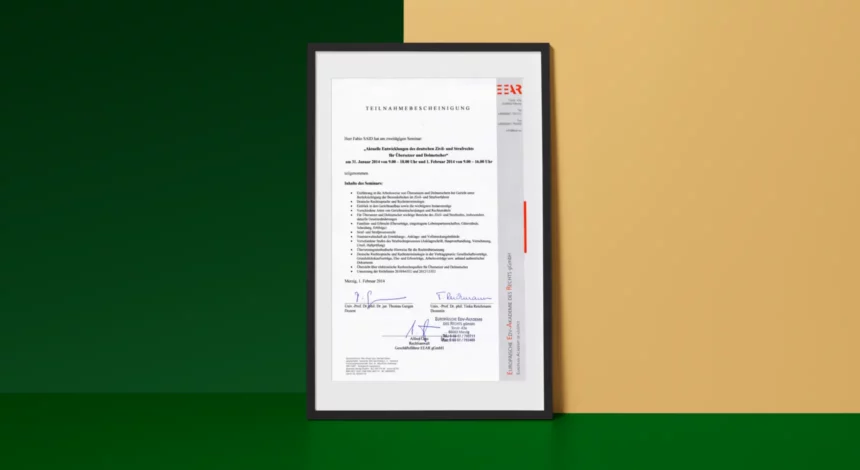
In late January 2014 I took part in a two-day seminar on current trends in German civil and criminal law for translators and interpreters held in Merzig, Germany. The seminar was organised by the Europäische EDV-Akademie des Rechts GmbH (EEAR) and was presented by Prof. Dr. Thomas Gergen (European University for Economics and Management) and Prof. Dr. Tinka Reichmann (University of São Paulo).
With speeches by judges Christiane Schmitt and Dr. Sigurd Wern, this continuing professional development event for linguists offered a unique opportunity to have a theoretical overview of both main legal areas and also to acquire specialised knowledge on a practical level.
Attendees were experienced legal linguists, most of them were also sworn translators in Germany. During group lunches and dinner we were able to continue exchanging opinions on several aspects of the translating profession in a more informal way.
Event details
| Type of event | two-day seminar held in German |
| Title | “Aktuelle Entwicklungen des deutschen Zivil- und Strafrechts für Übersetzer und Dolmetscher” [Current developments in Germany civil and criminal law for translators and interpreters] |
| Event organiser | Europäische EDV-Akademie des Rechts GmbH (EEAR) |
| Facilitators / Presenters | Prof. Dr. Tinka Reichmann, Prof. Dr. Thomas Gergen |
| Date | Europäisches EDV-Akademie des Rechts, Merzig/Saar, Germany |
| Place | 31st January and 1st February 2014 |
| Main topics | • An introduction to the work of translators and interpreters at German courts taking into consideration the specificities of criminal and civil procedure • A brief look at the structure of German courts and the most important stages of appeal • Several types of court judgements and legal remedies • Areas of civil and criminal law that are relevant for translators and interpreters • Family law and succession law (prenuptial agreements, civil partnership registration, marital property systems, divorce procedure) • Criminal law and criminal procedural law • Public prosecutors as judiciary body for criminal investigation, prosecution and law enforcement • The different stages of a criminal procedure (bill of indictment, main trial, hearing, court judgement, writ of habeas corpus) • Overview of digital sources of information for translators and interpreters • The language of contracts (articles of association, property sales and purchase agreement, prenuptial and succession agreement, contract of employment etc.) based on authentic documents |
